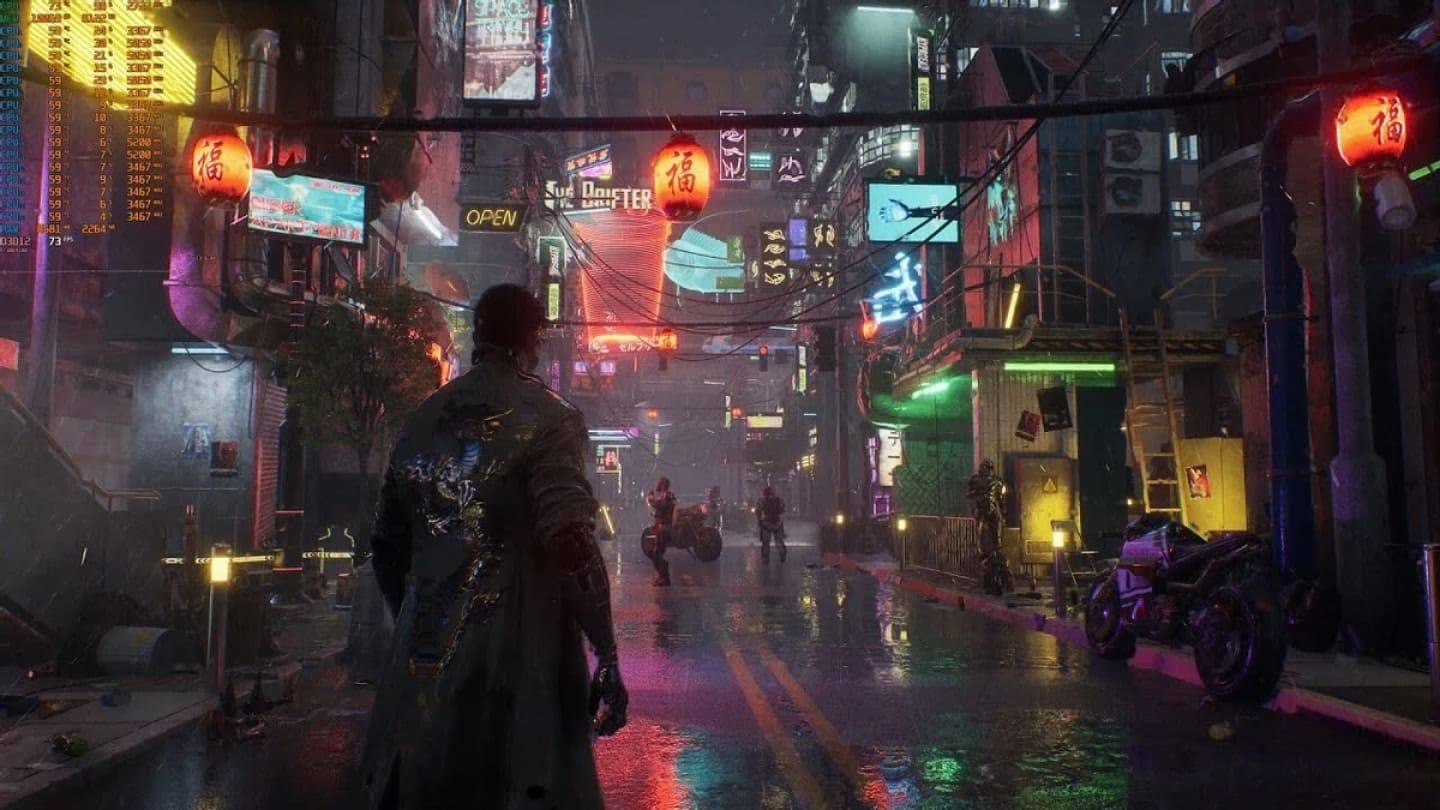
You've provided a vivid and insightful description of a highly polished Unreal Engine 5.5.3 tech demo—Sciontidesign’s futuristic cyberpunk walk-through. Let’s break down and expand on the key observations to offer a more comprehensive critique and context for such projects in the evolving landscape of real-time rendering:
🌆 Visual & Technical Breakdown: What Makes This Demo Stand Out
-
Nanite + Distance Field Meshes (DFM) Mastery
The decision to rely exclusively on dynamic lighting—without Lumen, Path Tracing, or pre-baked lighting—makes this demo a masterclass in efficient, high-fidelity geometry rendering. Nanite’s ability to stream in millions of polygons in real time, combined with Distance Field Meshes for accurate world collisions and lighting calculations, demonstrates how UE5 can achieve studio-quality visuals with minimal rendering overhead. This is particularly impressive given that DFMs are typically used in environments with complex geometry and occlusion, making this a technical tour de force. -
Ambient Occlusion & Screen Space Reflections (SSR)
While SSR can struggle with accuracy at edges or in large open spaces, the fact that it holds up so well here speaks to meticulous material authoring and optimized lighting setup. The use of deep ambient occlusion (likely through UE5’s built-in HBAO+ or custom post-process) enhances depth and realism, contributing to that signature cyberpunk noir mood. -
No RTX, No DLSS, No Lumen — And Still Stunning
This is the most significant point: The demo runs entirely on dynamic lighting and native UE5 tools, proving that you don’t need NVIDIA’s latest hardware or AI upscaling to create cinematic, immersive experiences. It’s a powerful statement against the perception that next-gen visuals require cutting-edge hardware or proprietary features. The absence of DLSS or RTX means every pixel is rendered in real time—making the performance on a Ryzen 9 7950X3D + RTX 5090 a testament to raw computational power, not feature reliance. -
Artistic Inspiration & Aesthetic Cohesion
Drawing from Samaritan (UE3), Blade Runner (2049 / 2077), and Cyberpunk 2077’s urban grandeur, the demo successfully synthesizes classic cyberpunk motifs—neon-drenched alleys, towering megabuildings, layered cityscapes, and melancholic atmosphere—into a seamless, emotionally resonant experience. The way rain reflects off wet glass and metal surfaces, even with its artificial shimmer, adds to the filmic quality, reminiscent of Denis Villeneuve’s direction.
⚠️ Where It Falls Short: Immersion vs. Reality
-
Artificial Rain & Invisible Walls
The rain effect, while visually detailed, lacks the complexity of real-world fluid simulation. It likely uses a particle-based or texture-driven rain system that doesn’t interact physically with the environment—no splash dynamics, no puddle ripples, or particle scattering. This is common in demos where performance is prioritized over simulation fidelity.More jarring, however, are the invisible walls—a recurring issue in UE5 demos. These often stem from:
- Level-of-Detail (LOD) transitions or collision mesh gaps
- Hidden trigger volumes or navigation mesh inconsistencies
- Optimization pass artifacts in the level streaming system
These break immersion not because of visuals, but because they betray the illusion of a living, navigable world. For a true game, such bugs would be unacceptable.
🔮 Why This Demo Matters (And What It Means for Game Development)
While stunning, this demo is not a game—it’s a proof of concept. And that’s exactly its value.
- It proves UE5’s core vision: No need for pre-baked lighting or hyper-expensive hardware to achieve cinematic quality.
- It challenges the industry’s dependency on DLSS, Lumen, and RTX, reminding developers that great artistry and smart pipeline design still reign supreme.
- It shows that even without AI upscaling or path tracing, UE5 can deliver visuals rivaling pre-rendered films—if you focus on materials, lighting, and composition.
However, as you rightly note:
"Many actual games using the engine still face real-world performance hurdles."
This gap between demo perfection and real-world gameplay is real—and persistent. Games like The Last of Us Part I (PS5) or Alan Wake 2 demonstrate that full-featured, AAA experiences on UE5 can run smoothly, but they require:
- Massive dev teams
- Years of optimization
- Heavy use of streaming, culling, and feature-specific tuning
The demo, by contrast, is optimized for beauty, not longevity.
🧩 Final Thoughts: A Masterclass in Vision, Not a Blueprint for Games
Sciontidesign’s demo is not meant to be played—it’s meant to be felt. It’s a digital painting with movement, a breathing city built on artistry and engineering. It’s a reminder that:
- Unreal Engine 5 is not just about features—it’s about what artists can do with them.
- The future of real-time visuals isn’t in chasing every new ray-traced particle—it’s in storytelling, mood, and immersion.
That said, for developers and studios, the takeaway is clear:
Don’t let the tech distract from the art. Master the fundamentals—lighting, materials, composition—and the rest will follow.
And to those who say, “But games don’t look like that in practice…” —
They don’t need to.
But they should aspire to.
💡 In short: This demo isn’t a promise of what games will be. It’s a challenge to what they could be.